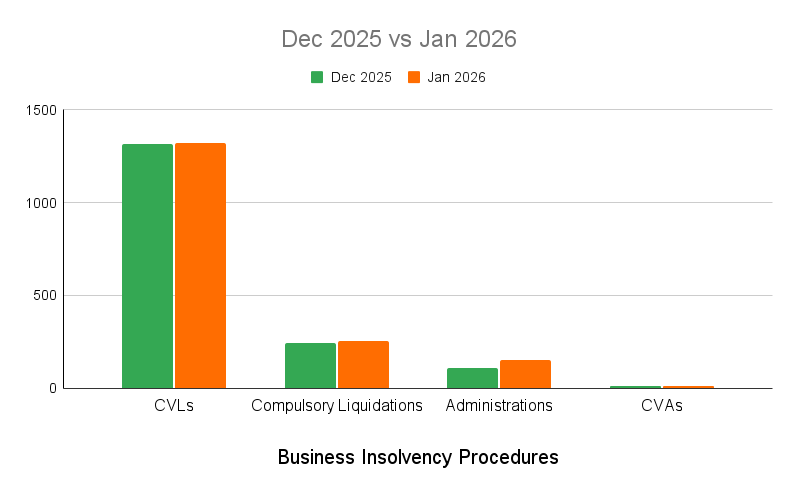
January is traditionally a tough month for many businesses, and the January insolvency numbers have reflected this. The Insolvency Service recorded 1,744 company insolvencies in England and Wales, showing the pressures of post‑Christmas dips in sales and cashflow. While this is a 4% increase on December, it is still 14% lower than January 2025, which is a positive sign that the picture is not as severe as it was a year ago.

Types and Amounts of Closures
Creditors’ Voluntary Liquidations (CVLs)
1,323 cases (Accounting for 76% of all insolvencies)
CVLs continue to be the dominant insolvency route, and the slight rise from December (1,315 CVLs in December) is promising and shows that more directors are taking proactive steps when liabilities escalate, rather than waiting for creditor enforcement.
Compulsory Liquidations
256 cases – up 4% from December 2025
The continued rise in compulsory liquidations shows creditors, particularly HMRC, are maintaining the pressure on directors. Although the numbers are still below the highest levels seen in 2025, this could indicate that Time‑to‑Pay arrangements are becoming harder to secure or maintain, and creditors are less willing to tolerate lengthy arrears.
Administrations
151 case – up from 107 in December 2025
The number of administrations in January 2026 was 41% higher than in December 2025. This increase suggests more businesses are looking for a way to keep trading or sell the company rather than closing down immediately. It shows that some firms are seeking help earlier, while there’s still something to rescue.
Company Voluntary Arrangements (CVAs)
13 cases – down from 15 in December 2025
CVAs were 13% lower than December in January 2026. Despite being a useful restructuring tool, CVAs may be seen as complex or expensive, especially if there are multiple secured creditors involved. Their limited use shows that while some businesses want restructuring, most still find administration or solvent negotiation more practical.

Sector highlights
In this latest release, the Insolvency Service reported that the industries with the most insolvencies in 2025 were:
- Construction (3,931, 17% of cases),
- Wholesale and retail trade; repair of motor vehicles and motorcycles (3,728, 16% of cases),
- Accommodation and food service activities (3,353, 14% of cases),
- Administrative and support service activities (2,446, 10% of cases),
- Professional, scientific and technical activities (1,991, 8% of cases).
- Manufacturing (1,943, 8% of cases).
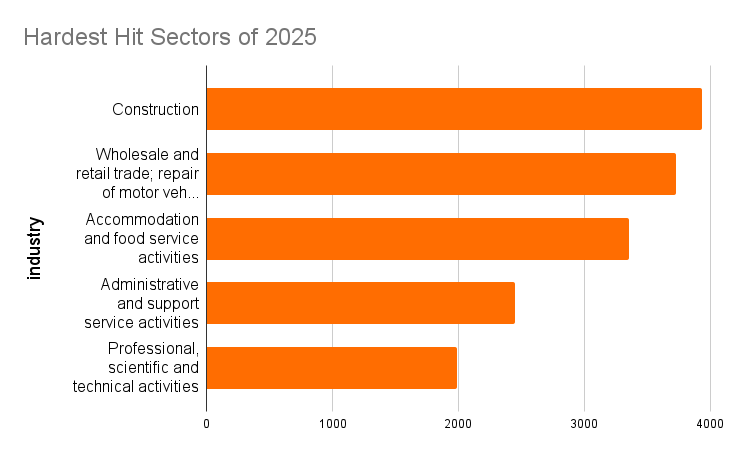
These sector numbers are quite similar to 2024, which could be seen as a positive that the pressure on businesses has not got worse. For businesses trading in or supplying these sectors, the figures show the importance of monitoring cash flow and tightening credit controls, especially where a large customer accounts for a significant share of turnover.
Richard Hunt, Insolvency Practitioner at Exigen Group, says:
“These January 2026 insolvency numbers follow a pattern we see most years after Christmas. Insolvency rates have improved slightly over the past 12 months, but the rise in administrations shows directors are asking for help sooner, while there is still something to rescue. CVLs suggest many directors are acting early and taking control, but the increase in compulsory liquidations is a clear warning, creditors, especially HMRC, won’t wait forever. Even if overall insolvency rates appear steadier than last year, the monthly volumes are still high, so directors should watch cashflow carefully and get professional advice as soon as problems start to appear. Acting early always gives more options.”